Showing posts with label Death in the End. Show all posts
Showing posts with label Death in the End. Show all posts
Monday, April 22, 2013
Frankenstein's Monster
The creation of Frankenstein's monster by doctor Victor Frankenstein features elements of Nature along with what can be seen as unnatural. Frankenstein's creation cannot physically be more than a patchwork of what has been given by nature; however, the mere synthesizing of life by the means of exciting an assemblage of corpse-parts creates a sort of divine, sublime or impossibly unnatural context. Frankenstein being attributed with qualities such as "God" can be rather suiting insofar that "God" is our way of conceiving Nature in the most impossible and unnatural of ways(as ourselves). God or Nature is a paradoxical juxtaposition of the same thing in the same way of Frankenstein's scientific breakthrough can be interpreted as an accomplishment in natural science or a horrid crime that is unnatural; the latter is assumed when we decide to conform Nature to what we think it should be this may seem rather ironic but this is to say Nature is limitless and unrestrained and all we can do is discover. We cannot say that Frankenstein's action was "creation ex nihilo" but rather a scientific discover of an attribute already immanent to Nature.

Friday, April 19, 2013
monstrosity as a whole
When it comes to considering humanity as a whole in
comparison to one human, the step is really wide in to the realm of
monstrosity. For one thing, when one person analyzes the world, he/she would
typically say that humanity is good but the world is cruel but when it comes to
questioning the good or evil of humanity as a whole, people most commonly same
that the world is good but humanity is cruel. And when we examine the nature of
Frankenstein’s monster, we could say he too is good but the world is evil to
him when it comes to analyzing the events for which he is a witness too. This
in a grander scale of comparing Frankenstein and the monster as a whole of
humanity would leave to the conclusion of the world being good but humanity
being evil because Frankenstein was miserable and alone he wanted to bring life
into something for him to have a friend but this selfishness that came by
wanting to create a human being on his own led him to greater sorrow and instead
of creating life he brought greater suffering to himself and his monster because
of humanities cruel selfishness.
Wednesday, March 27, 2013
Seasonal transitions
Although
both Keats’s “autumn” and Shelly’s “Ode to the West Wind” contain both seasonal
changes they have different interpretations of autumn. Keats interpretation contains
more of a dying love most likely a forbidden love that is flourishing “ close
bosom-friend of the maturing sun” but has to end due to natural circumstances-,
hence the autumn “death” and hook or scythe reference. He could also be referring
to his physical condition, the fact that he had developed tuberculosis that
very year of 1820 and would be dying very soon “summer has o’er-brimmm’d their clammy
cells” this sudden realization that once he was very healthy and lively but as
the summer ends and the fall approaches he too is falling apart and dying along
with nature. For Shelly I think the most probable reason for which he wrote Ode
to the West wind was because of his dear friend Keats’s illness “ whose unseen presences
the dead leaves are driven”.
Thursday, March 7, 2013
Fears and Regrets
In John Keats' poem "When I have fears...", he discusses two things that make him stick out in our hearts, and connect on a different level with him; he discusses fear and regret. We all have some fear or fears, and he isn't too afraid to admit that he is afraid: he is afraid of death, of dying at such a young age, and he is afraid of missing opportunities. The opportunities he has already missed make him regret that he never pursued them. How many people can say "I have no regret?", and truly, madly, mean it? There are next to none who can. I personally cannot say that. But what was Keats really trying to tell us, underneath all of this fear and anguish and regret from this poem? Maybe he was telling us exactly what could happen, if you just stop being afraid, and take the leap of faith. Or maybe he's trying to warn us NOT to take that leap, because it could lead to regret and remorse.
Wednesday, March 6, 2013
Evil before good
In Keats Epistle to John H. Reynolds he attempts to cheer up
his friend by mocking the views of society in how they treat people according
to social classes. He refers to great philosophers, poets, and artists as “Making
the best of ways towards Soho”(Epistle to John :line 12),meaning that even the greatest
of people go through social alienation and are miserable at first in order to
achieve great admiration. “Things cannot to the will be settled, but they tease
us out of thought; Or is it that imagination brought beyond its proper bound,
yet still confin’d lost in a sort of purgatory blind” (E to J 76-80) & “In
happiness, to see beyond our bourn it forces us in summer skies to mourn” (E to
J 83-84) both of this confirm Keats view of how first you must go through
unhappiness in order to be happy. This can be compared to Elizabeth Hamilton’s,
Translation of the letters of a Hindoo Rajah and her outside view into the
Hindu religion. According to the Hindu religion people are born into their
social classes and can never be reversed or altered but none of them hate or envy
one another. They are conformed and content to their class because” They believe
that the human soul must be purified by suffering, and that it is not till
after having undergone this expiatory discipline through a series of different
bodies, that it becomes worthy of admission to eternal happiness.”(Letters of
Hinddo Rajah). By Keats choosing to end the poem to his friend with a quote
from the twelfth night he left the decision to John Reynolds to think about how
his illness is the worst part and soon happiness will come “ thou art made, if
thou desir’st to be so”.
Wednesday, February 20, 2013
Aesthetic movements; sublime & picturesque in painting; ruins
Here is the main info from the presentation Mitch and I did:
Picturesque:
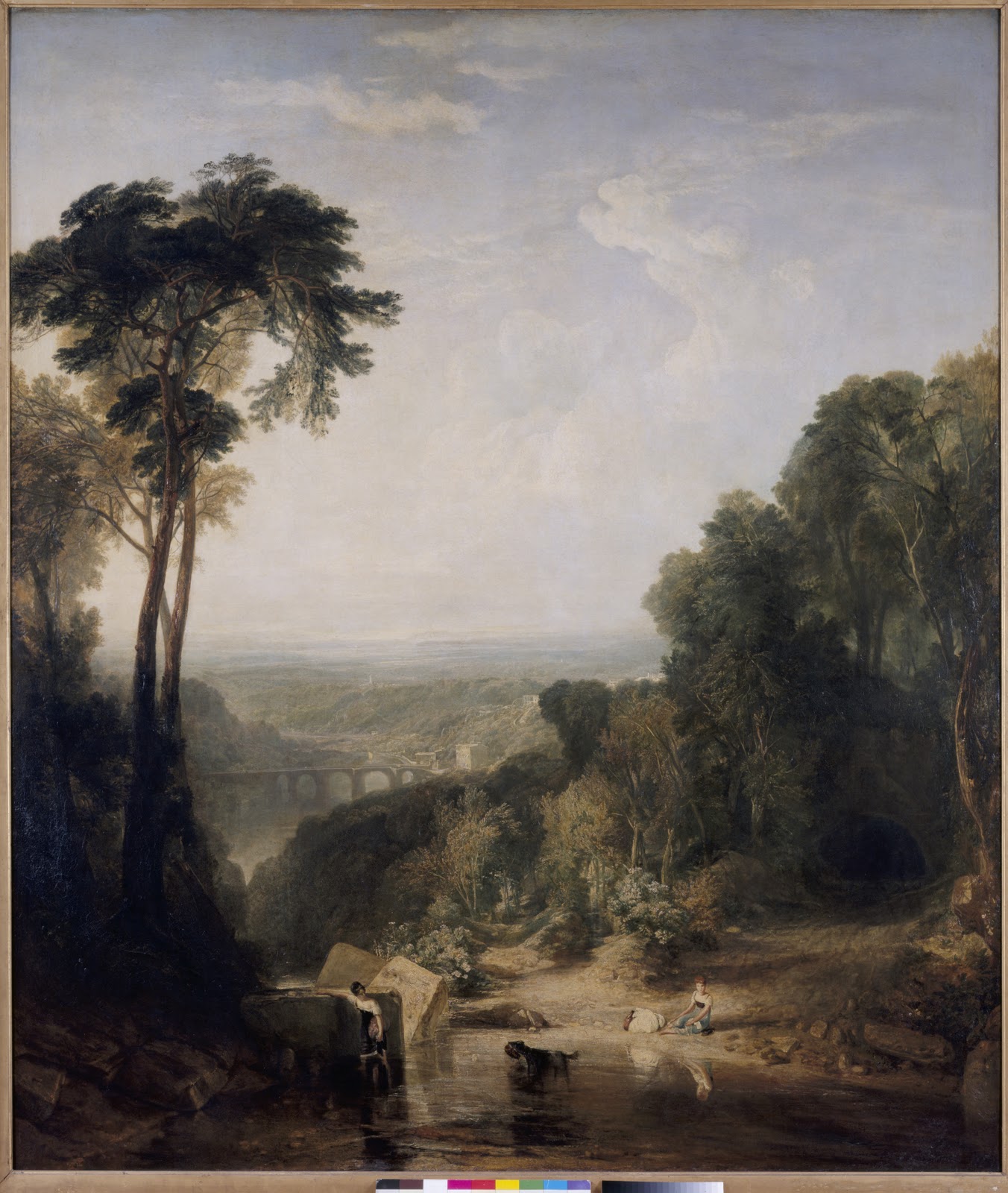
The picturesque is an aesthetic ideal that emphasizes a harmonious relationship with nature. The picturesque is generally pleasant to observe and has little sense of danger or tension.
Examples of the picturesque in paintings:
"Entrance to Copenhagen" by J.C. Dahl

"Crossing the Brook" by J.M.W. Turner
In this painting there is a more distinct interaction between people and nature (woman at river bank). There is also a solid structure in the background, emphasizing human beings harmonious relationship nature.
"The Wanderer Above the Sea of Fog" by Caspar David Friedrich
This painting is where picturesque and sublime meet. Nature is portrayed in a slightly more chaotic light, but the spectator is still on safe ground. Nature also borders on the sublime due to its awe inspiring characteristic.

Now for the sublime.
Sublime: Described by Victor Hugo as a combination of the "grotesque and beautiful", the sublime is an aesthetic ideal that emphasizes natures awe inspiring power and generally diminishes man to the role of a passive observer. Notice how small man is in relation to nature in both paintings.
Some examples of the sublime:
"The Great Day of His Wrath" by John Martin

"Hannibal and His Army Crossing the Alps" by J.M.W. Turner

Finally, ruins are important because they give an impression of a time of greatness that has passed. They are simultaneously a symbol of a time when the structure was great, and an aesthetic structure within themselves, presenting its own decay to the observer as an aesthetic experience.
"The Chancel and Crossing of Tintern Abbey" by J.M.W. Turner

Picturesque:
The picturesque is an aesthetic ideal that emphasizes a harmonious relationship with nature. The picturesque is generally pleasant to observe and has little sense of danger or tension.
Examples of the picturesque in paintings:
"Entrance to Copenhagen" by J.C. Dahl
"Crossing the Brook" by J.M.W. Turner
In this painting there is a more distinct interaction between people and nature (woman at river bank). There is also a solid structure in the background, emphasizing human beings harmonious relationship nature.
"The Wanderer Above the Sea of Fog" by Caspar David Friedrich
This painting is where picturesque and sublime meet. Nature is portrayed in a slightly more chaotic light, but the spectator is still on safe ground. Nature also borders on the sublime due to its awe inspiring characteristic.
Now for the sublime.
Sublime: Described by Victor Hugo as a combination of the "grotesque and beautiful", the sublime is an aesthetic ideal that emphasizes natures awe inspiring power and generally diminishes man to the role of a passive observer. Notice how small man is in relation to nature in both paintings.
Some examples of the sublime:
"The Great Day of His Wrath" by John Martin
"Hannibal and His Army Crossing the Alps" by J.M.W. Turner
Finally, ruins are important because they give an impression of a time of greatness that has passed. They are simultaneously a symbol of a time when the structure was great, and an aesthetic structure within themselves, presenting its own decay to the observer as an aesthetic experience.
"The Chancel and Crossing of Tintern Abbey" by J.M.W. Turner

Tuesday, February 5, 2013
The curse the opens the eyes of the Mariner
The Rime of the Ancient Mariner contained the basic structure
that both Wordsworth and Coleridge had discussed. The two Cardinal points of
poetry (according to the Biographia Literaria, chapter 14 (1817) in the
anthology of the conversations between Coleridge and Wordsworth) it had to
contain: The power of exciting the sympathy of the reader by the faithful
adherence to the truth of nature. The second was the power of giving the interest
of novelty by modifying colors of imagination. Coleridge achieved both of these
two points of poetry by adding both a spiritual force to the singing albatross and
by emphasizing color (to the water, dead corpse, water thirst lips, etc.) despite
the previous establishment of an eerie setting. The reader is able to sympathize
with the mariner once he realized that killing the Albatross was a mistake
because the bird helped the by bringing good luck to their voyage and instead
of him appreciating what the bird brought to them he killed, bringing forth a
curse to him, his crew and his ship. It isn’t till the end that he realizes
that he had taken his blessings for granted. After he “prayeth well, who loved
well both men and bird and beast.” “God who loveth us, He made and loveth all”.
The bird can be taken as a metaphor for slaves, they were taken for granted too
and once they were killed, and their life was missed because of their good
deeds.
“In consequence of the film of familiarity and
selfish solicitude we have eyes, yet see not, and hearts that neither feel or
understand.” …Wordsworth
Tuesday, January 29, 2013
The Thorn
Wordsworth's "The Thorn" tells the tragic story of Martha Ray and her troubling life. Represented by the thorn in the poem, she is plagued by heartbreak and the death of her child, which have led to the destruction of her life. Those events "all have joined in one endeavor/to bury this poor Thorn for ever" and as a result, she spends her time upon the hill, crying and lamenting her losses. Her life, once a promising one filled with love, is now one of tragedy and warning to the reader. Her story is mysterious; the narrator is unaware of the circumstances regarding her baby's death. Though she is alive, she has become a sort of ghostly, haunting figure, weeping on the hill for twenty years over the death of her child and the loss of her love. She is unable to escape the tragedy of her past, it is made clear that "the Thorn is bound/with heavy tufts of moss that strive/to drag it to the ground," and she is left to haunt the hill with her misery.
The symbol of the thorn
That Wordsworth's poem is about more than a simple thorn on a simple hill is easily enough discerned in the text. The tale of Martha Ray and her woeful cries on the hill that may hold the body of her infant child is one of betrayal, anguish, and love lost. It is a tale of a thorn. The thorn becomes a symbol for her whole ordeal. It is the prick of her lovers betrayal. It is the stab of finding herself alone and with child. The thorn, overgrown, is the child she may have killed. Just as the story of betrayal is an old tale, so is the thorn itself. This is not the thorn of a rose, balanced with the sweet smell of the flower. This is the thorn of bitter anguish, without redeeming grace. The scarlet of Martha's cloak echoes the blood this thorn draws. Just as the thorn is bound with moss to the hill, so is Martha bound to the hill. This is something that transcends the mortal realm. The hill itself has become a symbol, something wholly "other". The hill itself rebuffed the townspeople's intent to find the bones of the infant, it rebuffed mortal intrusion into its otherworldly realm. We can but look upon the hill, we can but mark this sad tale, unable to change it. We are observers, who may, if we are fortunate, glean some lesson from the hill, the moss, the thorn, the pond, and the woman. While Martha may have once been mortal, she is now wholly symbol, undying, unchanging, like the hill itself. And the thorn, which never lives, yet never really dies, like her pain, and the death of her child.
Tuesday, January 22, 2013
Prophecies and Destruction
I found it interesting that the central force behind this
story was a prophecy. Prophecies seem to always be the subject’s self-destruction.
This story is a perfect example of self-destruction based on a character’s fear
of prophecy fulfillment. The prophecy
states, “the castle and lordship of Otranto should pass from the present
family, whenever the real owner should be grown too large to inhabit it". In
the beginning, Manfred fears his people’s whispers of the prophecy. It seems to
loom over him. After the death of his only son, Manfred goes to extreme lengths
to try and secure his lineage. He still has Matilda, but due to the perceived
necessity of a male heir, he ends up killing his daughter and only other heir.
This fulfills the prophecy he tried so incredibly hard to disprove. He made it
true by trying too hard to disprove it and ended up losing his family over it.
Rightful Inheritance and the Supernatural
It's interesting to note that throughout the story when a mysterious situation takes
place, typically the supernatural elements correlate to one of the themes; one
theme in particular being rightful inheritance. Conrad's death, resulting from
the fallen helmet that resembles Alfonso's helmet, is an unnatural way to die.
It puts emphasis on the supernatural aspect of the helmet killing Conrad, son
of Manfred and it seems that the main focus is the importance of the helmet and
Alfonso and what he reflected. Alfonso reappears
other times in mystical forms and alludes to rightful inheritance. Rightful inheritance
that specifically doesn't belong to Manfred, but instead Theodore.
Subscribe to:
Posts (Atom)