Showing posts with label deadlyxpromise123. Show all posts

Wednesday, May 8, 2013

Being Human


        Over the semester, the thought of monstrosity has evolved my mind, and with it, the notion of its lighter twin humanity. As much as I tried to get away from this theme of monstrosity, it seemed to infect many of the texts that we read like a plague, and it intrigued me. Monstrosity seems to take over the humanity side of literature and people, the lighter side of humanity leading into the darkness that is monstrosity, but the beauty of being human at some point shines through over the welcoming abyss of the monstrous.

        For most of the literature that we have read, it seems to be the human mind that is the very essence that monstrosity itself comes from through an overflow of emotion. An obvious example of this is from Shelley’s Frankenstein. In it, Victor Frankenstein strives to actually create life. This was his gradual downfall to him giving into monstrosity through his desire of discovery to be on the level of God after he saw the raw power and beauty of lightning and what it could create as he relayed back to Robert Walton, “I beheld a stream of fire issue from an old and beautiful oak . . . and so soon as the dazzling light vanished the oak had disappeared, and nothing remained but a blasted stump . . .. I eagerly inquired of my father the nature and origin of thunder and lightning. He replied, "Electricity” (Shelley, Frankenstein). It is his drive to re-create life that leads him to creating the monster, but because of it, he falls to his human side of distorted wonder. "Ambition drives Frankenstein to create the monster in the first place, and without it the tragic ending of the story could have been avoided completely. Had he contented himself with ordinary scientific pursuits like the rest of his colleagues, none of his family would have been murdered. As Frankenstein has learned by the time he lies on his death bed, even a purely innocent intention can blossom into a full-blown disaster" ("The Relationship between Frankenstein and His Creature"). And honestly, it was after reading the graphic novels that Frankenstein truly scared me because I could see myself falling into the same trap as Victor did as well because there is so much beauty in power and dreams. For a brief second, I could feel a flicker of that desire in me, and I wonder how terrifying it must have been for Victor to see himself in his creation as well. As +Maposa said in the post “Dreams” in relating to “The Expedition to Hell” by James Hogg, “People had a dream that they tried to create, but then they lost control and it became a nightmare. Of course, this was the picture that came to mind.


This was used in my presentation with Cassie for Monstrosity and Education focusing on Frankenstein, and after our presentation, one of our classmates Maia went back to this specific picture from our slides. This was where she talked about the doppelganger effect that is used for Victor Frankenstein and the monster and how it was interesting that they both have the same face. From there, both Alex and Mitch pointed that this could be a symbol for the relevance between the creator and the creation. Though Victor was the one who made the monster, he saw himself in the monster; and perhaps that was what scared him the most, that he could see a reflection of him in the monster or the monster in him. These may be just mere stories of fiction, but even fairy tales come from reality. Every lie is derived from the truth at some point. As my high school English teacher told me, authors write from what they know, and this is a part of what authors such as Shelly knew, that this monstrosity, and the humanity thereof, is our story.

 The same is seen in the poem “I Am” by John Clare. As Thomas H. Schmid says in Addiction and Isolation in Frankenstein, “The real horror in the sufferings of a Frankenstein’s creature, a Victor Frankenstein…is that such experiences can never be adequately communicated to “normal” members of society, to those who have not been similarly exposed to the ‘dark truth’; the real horror is to be alone in the knowledge of that truth” (Schmid, Addiction and Isolation in Frankenstein). The continuous spiraling path down to loneliness and despair of having nothing else is what drives them to become monsters.


From the second stanza of “I Am”,

“Into the nothingness of scorn and noise,
Into the living sea of waking dreams,
Where there is neither sense of life nor joys,
But the vast shipwreck of my life's esteems;
And e'en the dearest--that I loved the best--
Are strange--nay, rather stranger than the rest.”

It is as +Rose Thassally’s “Reaching for More or Humanity is “Never Satisfied” says as she talks about this poem, “the need that people have to want something beyond all sanity is frightening in and of itself because we recognize that theirs a limit to when we just have to stop, but obsession can of course drive people to do insane things…” The unknown of our capacities and the overwhelming emotions lead us to becoming more monstrous than we can imagine.

        Leading on from that, +Urizen’s post “We are the Monster,” expands off of this discussion. In Urizen’s words, “Those researching stem cells, splicing human and animal DNA and other areas are accused by their detractors of “playing God”… We are the children of the mob and the monster. Which leaves us with a question. Will we be the children of Prometheus? And what does that mean? Does it mean reaching to lofty heights and falling miserably, or does it mean daring to reach beyond what is known into the unknown, and carry the ‘fire’ of knowledge and science as far as possible, no matter the cost?” This was something I related to in my post “Monsters and the Unknown” as well, that the monster itself could very well be dwelling on the inside of the human mind. Still though, with monstrosity comes the humanity part of us. It is similar to demons and angels. In our minds, demons and angels are two completely opposite creatures, one surrounded by pure light while the other is encased in treacherous darkness. Yet, we fail to remember that these two creations came from the same body as seen in this picture below.
.
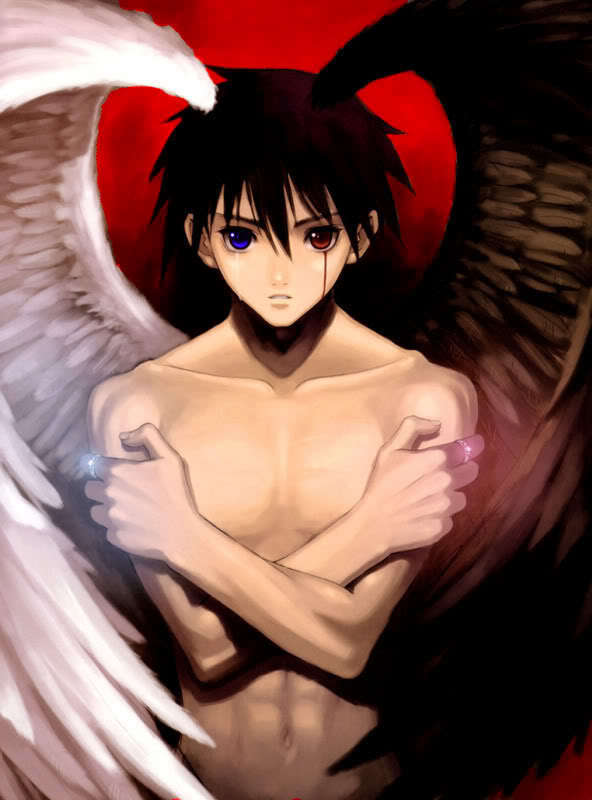
        Demons emerged from the holy angels by a surge of emotion and empowered pride, and from that, they were torn away from their past bodies as angels to the distorted demons that they are known as now. Monstrosity itself was made from what is human about us, curiosity, discovery, the want and desire for more. Yet, an over-power of emotion and the humanity in us crosses over that fine line towards monstrosity. From that bloomed this thought. What makes people monsters, and if we as humans can become the monstrosity, then can we very well become humanity?  

        Take William Blake’s “Songs of the Innocence and Experience” for example. In this, the monster is obviously not an actual creature that was made from spare animal parts and lightning, but both have one thing in common – the human reason that resulted in the monster that was created.  Rather, the monstrosity is seen from the human race itself as the innocence of a child being stripped away from the children in slavery because of the human desire or need for prosperity. These were young children forced to do harsh labor, and for us looking at it now, all that can be thought of is where is the humanity in this?


Even just looking at this picture makes my stomach churn uncontrollably, yet this was what Blake wanted us to know that we had succumbed to through his poems. Tearing them away from their family, selling them as piece of jewelry, taking away their innocence – this was the monstrous activities that the human race had succumbed to. One has to question if there is even a place for the pure human heart to reign again, but even Blake didn’t write his poems merely to show the monster that they had become. As we mentioned in class when we read these poems a couple months ago, he wrote to change the mind of the people and draw them back to humanity for as the book Kino no Tabi states, “The world is not beautiful, therefore it is” (Sigsawa, Kino no Tabi). Blake saw that this world was not a beautiful one. In fact, it is a rather monstrous one. Humans can do such terrible things, but there is still beauty in the human race, and there is beauty from the monsters because there is beauty in humanity.

        Perhaps one of the best stories to show the beauty of humanity is from John Keat’s “Lamia.” In it, he describes, for lack of a better word, a monster. More specifically, she’s a serpent-lady. And through it, he uses his words to paint a picture of this monster, but rather than giving her grotesque qualities as expected, he exposes her beauty though she was a demon.

“Eyed like a peacock, and all crimson barr’d;                        50
And fill of silver moons, that, as she breathed,
Dissolv’d, or brither shone, or interwreathed
Their lusteres with the gloomier tapestries –
So rainbow-sided, touch’d with miseries.

Her throat was serpent, but the words she spake               65
Came, as through bubbling honey, for Love’s sake,
And thus; while Hermes on his pinions lay,
Like a stood’d falcon ere he takes his prey.”

He tells of her beauty instead of the monstrous side of her, using “volcanic imagery so there is this feeling of burning away her old form to create the new one” as +Maposa had said. She may have been a serpent and quite monstrous to the eyes, but she had human features that related her to humanity and gave her beauty.

       Of course, humanity does not always come so easily. Even Frankenstein’s creation was grotesque in looks, and as +BIGred13 pointed out, Victor’s desire for creating something beautiful turned into a monster. However, the beauty of humanity does not lie in the easy or pleasantries of life. Rather, it dwells in the human desire to not allow the darker emotions control their actions to where their dreams have become nightmares. Because, “If Lamia demystifies the sentimental romance, it similarly demystifies naive realism. Lamia demonstrates that we cannot help but see romantically: it is only through such selective seeing that it is possible to discriminate identities at all” (Endo, “Seeing Romantically in Lamia). Lamia did not simply become beautiful through John Keats’ words painting her in romance. No, she grew beautiful because she was human. She felt pain; she felt love; she felt desire. She felt herself become more than the monster that she was because she knew through Hermes, she had a way to cross over that line to humanity.

      Loneliness, curiosity, desire, power, passion, dreams – these are all elements that can’t simply be hidden away as part of human nature. They are not things for us to be stripped of either for they are what makes us human, but one foot too far into allowing it to consume the human mind and dangerous monstrous things can from within. That is the trick to being human though and maintaining our humanity because the world is dark and monstrous and filled with many treacherous things, but beauty of humanity is still everywhere.


Works Cited:

Schmid, Thomas H. Addiction and Isolation in Frankenstein.
Ebscohost. University of Texas at El Pasp, 1 Nov. 2009. Web. 8
May 2013.

Endo, Paul. Seeing Romantically in Lamia. English Literacy History. Johns Hopkins 
University Press. 1999. Web. 8 May 2013.

“Frankenstein: the Modern Prometheus.” Mural.uv.es. n.d. Web. 8 May 2013.

“The Relationship between Frakenstein and His Creature.” JTBrandt. N.d. Web 8 May


Tuesday, April 30, 2013

We are the Monster

What is the legacy of Frankenstein? In both graphic novels posted, we themes presented that endure to this day. Mary Shelley was more than a writer. In many ways she was a prophet of the 20th and 21st century. Electricity, biotechnology, limb replacements, "designer" genetics, gene therapy, all these innovations in many ways go beyond what Mary Shelley envisioned, and yet are becoming more and more commonplace today. In a way, we are all Mary Shelley's children. Our culture also bears the mark of Victor Frankenstein.  Those researching  stem cells, splicing human and animal DNA and other areas are accused by their detractors of "playing God." The question of "how far is too far" is perhaps even more relevant today than during the time the novel was written. We are also Victor Frankenstein's children. And what of the monster? Our culture is becoming more and more heterogeneous. Immigration, gay rights, multiculturalism, and other issues have stratified this country more than at almost anytime in history. At a fundamental level, groups in this nation speak a "different language" and lack an understanding of the thoughts and motivations of others. Such a culture reacts with fear and violence when confronted by that which is does not understand. We are the children of the mob and the monster. Which leaves us with a question. Will we be the children of Prometheus? And what does that mean? Does it mean reaching to lofty heights and falling miserably, or does it mean daring to reach beyond what is known into the unknown, and carry the "fire" of knowledge and science as far as possible, no matter the cost.

Monday, April 22, 2013

The Electric Beauty

Put simply, I love reading. There's a joy that can't be explained when the words from the pale yellow pages transform into a never-ending picture in your head. I also love reading comics because I love seeing my favorite characters come to life not only in my head but right in front of me on paper. It's an art form that In Frankenstein: The Graphic Novel, there's a scene on page 15 that completely took my breath away because that's when the idea of electricity and the beauty that Victor was seeing really stood out to me because you can imagine the scenes chapter by chapter in your head, but sometimes, words do not replace the beauty of an art work. . It's the part in the comic where Victor is telling his story, beginning with his life. He goes on to tell about a huge thunderstorm that overcame his home growing up and the lightning that struck the tree outside. When I got to that page, the colors were so vibrant that I couldn't look away. The lightning was characterized by a "KARAK!" and the bright white of the lightning against the dark broken tree trunk pulled me in. For a brief second, the artist was able to pull me away from my world into the world of color and entrance me in the beauty, and for that little while, I knew why Victor was so consumed by the idea of lightning and electricity. The depiction of the lightning hitting the tree held so much power and yet elegance, and that was what Victor saw in it, the beauty of the natural electricity. Just for a second, all of that came to life, and I understood.

Frankenstein

Victor wanted to create something beautiful and sublime, instead getting a monstrous creature. What if the creature had come out aesthetically picturesque and pleasing? Would both Victor and the community be more patient and understanding? They would know the truth of how it was created - unnaturally with bits and pieces of humans and animals - but because its beautiful would they be accepting, or still see it as monstrous on the sole basis of what it is; not a natural being. If the creature looked like a normal person, would Victor and the community be more willing to work with it in order to teach it to be like them? To be more human? If so, would they always secretly live in fear of what is inside of the creature?

Friday, April 19, 2013

monstrosity as a whole


When it comes to considering humanity as a whole in comparison to one human, the step is really wide in to the realm of monstrosity. For one thing, when one person analyzes the world, he/she would typically say that humanity is good but the world is cruel but when it comes to questioning the good or evil of humanity as a whole, people most commonly same that the world is good but humanity is cruel. And when we examine the nature of Frankenstein’s monster, we could say he too is good but the world is evil to him when it comes to analyzing the events for which he is a witness too. This in a grander scale of comparing Frankenstein and the monster as a whole of humanity would leave to the conclusion of the world being good but humanity being evil because Frankenstein was miserable and alone he wanted to bring life into something for him to have a friend but this selfishness that came by wanting to create a human being on his own led him to greater sorrow and instead of creating life he brought greater suffering to himself and his monster because of humanities cruel selfishness.   

Tuesday, April 16, 2013

Monsters and the Unknown

As I was reading Frankenstein, an interesting thought came to mind, and that of course is the thought of monstrosity. But more than monstrosity, it is the very notion of monstrosity and what makes it so. This specifically came to my mind after the events that happened yesterday with the bombing of Boston, which is obviously seen as a monstrous action that someone had committed. This begs to mind though, what is the very definition of monstrosity? We all talk about monsters in a very general sense, monsters hiding our beds, monsters with the sole purpose to scare us as if they have nothing better to do than waste their time making our lives miserable. Why? Because they're monsters. That's all that there is to it. But there's more than that, so much more than that. In our simplistic minds, we simply view monsters as these creatures or beings that exists only to torment, but surely something happened to them to make them so. There had to be some reason, some event, some anything that slowly changed them into the monsters that they are now. The term "monster" is so overused and undefined that it begs the notion of what a monster truly is. Just a simple search on Google presented this:


mon·ster  

/ˈmänstər/
Noun
An imaginary creature that is typically large, ugly, and frightening.
Adjective
Of an extraordinary and daunting size or extent.
Synonyms
noun.  monstrosity
adjective.  huge - enormous - monstrous - prodigious - tremendous
This can't stand to be true. Monsters truly take all shapes of forms and sizes. That's what makes it so terrifying. The monster itself could be dwelling inside the human mind, the pounding heart, the actions of a people or a being. There is one thing that monsters have shown us through Frankenstein however. The fact that the creation, Frankenstein's monster, had a mind. It had parts of humanity involved in its creation. That is the true monster, the emotions that rage out of control, the despair that became too much to handle, the fear that drives you to the end. The monster itself - it has the potential to rage through everyone because all monsters have a mind to be able to commit the things that it does. That's what makes a monster, not that it has emotions, but that it pays no attention to the control of emotions and lets go of everything that makes the person human.

Wednesday, April 3, 2013

Reaching for More or Humanity is "Never" Satisfied

In the spirit of Kubla Khan is a poem about reaching for something beyond yourself and basicly not getting it. The problem with the narrator in I Am by John Clare is that they want to be closer to "god" or a godlike being because they feel they have nothing left so being something other than what they are is appealing. The need that people have to want something beyond all sanity is frightening in and of itself because we recognize that theirs a limit to when we just have to stop, but obsession can of course drive people to do insane things, such as bringing a dead person back to life when you "know" a person is suppoused to stay dead in Frankenstein. Humanities struggle to keep going even when your not sure where your going too is something that in the narration of the poem is explored where the narrator simply wishes to return to something or be reborn into a life where they aren't in pain or suffering from depression since the tone of the poem seems to lean that way.

Tuesday, April 2, 2013

Byronically Brilliant


While reading the poem, I thought it was so intriguing that he would use two people who were so recognized in the literary community, Southey and Coledridge. It almost seemed as if he was making a satire out of Coleridge’s, and by extension, Bob Southey’s beliefs. For you see, these two had plans for a political uptopia where everyone would work for the common good of the community. Byron apparently did not agree with this thus resulting in his lovely wordy elaborate poem Don Juan. Glorious and very well played Lord Byron because not only did he use two important literary figures who already had a connection with each other, the poet laureate and the founder of Romantic Movement, but he also used the connection that they had against them, showing first off Southey as a hero for his venture to try to establish “with all the lakers” (the Lake Poets) his perfect society and his position as a poet laureate in the very first stanza. As poet laureate, he is seen as some kind of a hero, a hero with his words if you must. However, Byron draws on the fact that the society which Southey wanted to establish was crumbling because Coleridge (a Lake Poet) did not agree with him on the location for it for even the perfect hero of literature (if pushed into that position of Poet Laureate as was the case for Southey) can crumble himself.

The direct tie into the second stanza is with the mention of Coleridge, using the metaphor of “too has lately taken wing, but like a hawk encumbered with his food” for though they both didn’t agree on a place, Coleridge still spread his idealogy to the people, telling them of the tales of this perfect society of how this would happen. You see, Byron establishes the very skeleton of a Byronic hero simply in these two stanzas. Broken, beaten, trying for the better good – these characteristics of the Byronic hero are established in the knowledge of these poets, and Byron uses it to show that even the best of the literary heroes will fall, but their ideas will never die, not while the word still lives. Perhaps that is the true political sense of it, that ideas that have the potential to change society will never die. The trick is that someone must understand it which Byron shows that many people can’t by the words “I wish he would explain his explanation.” They may be literary Byronic heroes pushing for their own political views, but Byron uses that to his advantage, using their acts and position as such to show his own political view. He makes a satire out of them in order to show his audience what he thinks which if you ask me is Byronically brilliant.

Tuesday, March 26, 2013

Green Eyed for the Nightingale

In the first stanza of "Ode to a Nightingale," Keats establishes a strange, almost childish mood. He talks about his "drowsy numbness," which seems to either be caused by drugs, his own emotions, or both. However, the childish attitude shows through in his jealousy for the nightingale. He says that it is not envy that drives him, but rather, he just cannot understand how the nightingale can be so happy. This rejection of jealousy serves more to prove Keats' jealousy, rather than defy it, because he does seem to envy the nightingale's happiness. The nightingale sings about summer, something it misses, with the same happiness as if it were summer then. There should be a feeling of longing from the nightingale, a feeling Keats cannot rid himself of, and this is driving him mad. Keats wants to be as happy as this nightingale, who rather than feeling intense longing after a loss, feels happy just thinking about what was lost.

Wednesday, March 20, 2013

Therefore It Is

I was drawn into Keat's description of the serpent-lady. I expected something grotesque, but along with the writing style, the serpent-lady was painted in such a way that I could only describe it as beautiful.


"Eyed like a peacock, and all crimson barr’d;        50
And full of silver moons, that, as she breathed,
Dissolv’d, or brighter shone, or interwreathed
Their lustres with the gloomier tapestries—
So rainbow-sided, touch’d with miseries,"
The similes simply flow from one to another using words that exhibit color, "eyes like a peacock...full of silver moons...dissolv'd, or brighter shone..." This all drew me in and enticed me even though she was but a demon.

"Her throat was serpent, but the words she spake
Came, as through bubbling honey, for Love’s sake,        65
And thus; while Hermes on his pinions lay,
Like a stoop’d falcon ere he takes his prey."
Even after he reveals her anatomy, her words that "came, as through bubbling honey" creates a film over her true identity, making her seem even more lovely than she is intended to be. Perhaps this is done in an effort to draw his own audience in to realize that even the perceived notion of something that is unpleasant could be beautiful.

Known and Unknown Monsters

When we are introduced to Lamia she is described as a serpentine monster with some redeeming human features. Only after receiving aid from Hermes does Lamia become a beautiful woman. Geraldine seems to be normal throughout “Christabel,” aside from several hints: needing help over the threshold in line 131, the growling dog in line 148, and the mark on her chest in line 252. Yet even though Lamia is the more physically monstrous, Geraldine strikes me as more evil. Lamia is motivated by her desire to be with Lycius. Geraldine is never given any motivation but the reader is still led to believe she has some ill intention. The mystery surrounding Geraldine makes her appear sinister. In reality there is not much to indicate that Geraldine is evil but Coleridge sets the reader up to believe that she is. Keats describes a monster but gives her motivation that is somewhat innocent. Geraldine, to me, is more frightening than Lamia because she is entirely mysterious.

Tuesday, March 19, 2013

Suggested horror vs. the horror in the details.


I found the differences between the two transformation scenes quite interesting. In Christabel, Coleridge does not describe what is under Geraldine’s robe. Lines 252-254 say, “Behold! Her bosom, and half her side – A sight to dream of, not to tell! O shield her! shield sweet Christabel.” It is as if the horror underneath those robes is too much to bear for Christabel, so the reader is put into that same position of turning away from it. Coleridge leaves it to the reader to imagine what horrifying things are under that robe. 


In contrast, Keats description of Lamia is very detailed with multiple colors, stripes, spots and peacock eyes. For this reason, Lamia doesn’t come across as scary as Geraldine does. With Geraldine, there is a fear of the unknown, but with Lamia, especially with the description of lines 47-67, there is no fear because you are too busy trying to imagine what this creature with a snake’s head, but a woman’s mouth looks like. There is more revulsion than fear. 


That continues when you get to witness the transformation of Lamia in lines 146-170. You would think the transformation of a serpent-like creature into a woman would be a magical experience, but Keats is very specific about what goes on. It’s almost like a chemical reaction with the way she foams at the mouth and the release of phosphorus and sparks. Keats uses volcanic imagery so there is this feeling of burning away her old form to create the new one. Before this, Lamia seems a bit devious because of the way she bargains with Hermes to get herself turned into a woman, but I found myself more sympathetic towards her after this description of her painful transformation.

Tuesday, March 5, 2013

Dreams and Reality: Separate but Equal?

I know this is a bit retrospective, but this didn't really occur to me until class. Dreams are something that, in our Post-Modern world, are again seen as an important literary subject of study. The difference, however, between the Romantic view on dreams and the Post-Modern view is the separation between dreams and reality. The Romantics try to establish a very clear difference between the two, keeping them as two different worlds which, while they coincide, are still separate. The Post-Modern period is often identified, by contrast, with the advent of Magical Realism, which weaves reality and dreams together to a point where they are often inseparable. The question then is which view makes the most sense or appeals the most to you? They both have credibility, as dreams clearly operate separately from reality, but equally, dreams and reality hold equal sway in many cases, and both are merely different shades of perspective. So which opinion on dreams do you all prefer?

Tuesday, February 26, 2013

Mystery & Sanity


"Hence, horrible shadow!
Unreal mockery, hence!" 

These lines are spoken by Macbeth upon seeing Banquo's ghost, an event that symbolizes Macbeth's descent into madness. Lady Macbeth begins to lose trust in her husband and his sanity at this point. Similar, this quote begins a chapter in which many of the characters continue to lose trust in La Motte. His wife still believes that he is having an affair with Adeline, and his private meetings with the Marquis leave the rest of the inhabitants of the abbey uneasy. La Motte's behavior becomes increasingly mysterious throughout the chapter, specifically in his encounters with the Marquis, leaving both Adeline and Madame La Motte worried for his well being. Adeline suffers from "anxiety for the welfare of La Motte" in the same way that Lady Macbeth does during her husband's insane outburst at the banquet. Madame La Motte views "the mysterious conduct of La Motte" with "a pang of self-accusation," and feels guilt similar to Lady Macbeth's guilt over planning the murder of the king. Quoting this specific act from Macbeth makes the reader skeptical of La Motte's sanity and intents as well, and adds to the mystery of the novel. The quote also lends a gothic tone to the chapter by referencing such a well known scene with supernatural elements.

Story of a Girl


Odes of Passion (page 172)

"And Hope enchanted smil’d, and wav’d her golden hair;
And longer had she sung-but with a frown,
Revenge impatient rose…’"

It’s only three lines, three small lines, but those three lines describe so much about that girl, the one girl who is gorgeous beyond simple world but carries on too much in the world. As I read it, that was the pressing thought in my mind. I seem to have a pressing thought for every text that we read (which I suppose is the main point of doing these readings in the first place). It also reminded me of the song “Story of a Girl” because that is the entirety of the song, it is a story of a girl who cried a river and drowned the whole world, but while she looked so sad in photographs, I absolutely loved her, when she smiled (and I digress). Seriously, you all should listen to the song if you haven’t already. That is the song of my childhood.

At first glance, this poem evidently is meant to show something about the female main character Adeline. That seems simple enough, and the ode itself does present that. Standing by itself, I would have just assumed that it was meant for any normal girl because for every girl, and every person for that matter, has been through something that makes them a rose stuck in a bushel of thorns. Put before the chapter however, the “Ode to the Passions” leads the reader into this belief that its placement is obviously of some significance. Similar to a post that I read before, the ode acts as the music before a battle or love scene in a musical or movie before it leads into the actual actions, focusing the audience on that raw emotion to help intertwine them with the story and the characters. It is meant to draw attention to Adeline and her beauty that took Theodore’s heart, which is exactly what the following two paragraphs tell of. It describes the encounters that Theodore had with Adeline and his thoughts on her, how her presence had touched it along with his remembrance of another poem that too describes beauty.

“Oh! Have you seen, bath’d in the morning dew,
The budding rose its infant bloom display;
When first its virgin tints unfold to view,
It shrinks and scarely trusts the blaze of day?

SO soft, so delicate, so sweet she came,
Youth’s damask glow just dawning on her cheek.
I gaz’d, I sigh’d, I caught the tender flame,
Felt the fond pang, and droop’d with passion weak.”

The different poems both resemble each other in that regards, showing painted words of beauty and comparing the girl to a sweet rose. The third paragraph following the second poem though, continues on the second part of the ode, telling why Adeline was “but with a frown, revenge impatient rose” because it is here that Theodore realizes about how Adeline has been hurt, how this entire situation had marred her, leaving her but a delicate rose on the outside and a very impatient, hurt, and scarred by thorns of circumstances. True the second poem serves to amplify Theodore’s initial view on Adeline and her beauty; however, the ode shows us more than her superficial characteristics. It shows us the state of her heart. What stuck out to me even more is that the chapters coordinate with the three lines of the ode, first of her beauty, then of her unrest, and lastly of her brokenness. 

Tuesday, February 12, 2013

What is true?

As I was reading the Songs of Innocence and Experience, I just had this replaying thought of innocence pounding in my head matching to the drumbeat of a song I was listening to. Clearly, this is a theme that is evident in the poems. It is even in the title, but the twists that Blake uses with innocence caught me off-guard with both of the chimney sweepers. At first, I thought that the child in the Songs of Experience was the depiction of innocence. After all, that's how most children come into the world, innocent, naive and free from the troubles and the hardships of life, but then I saw the depiction of experience and innocence in the Songs of Experience being stripped from his innocence by his parents so that he may know the woes of the world. It was as if they were saying that innocence can only be truly innocence if taken away first. This is seen in both poems. In the Songs of Innocence, the chimney sweepers endured great hardships and were near death cleaning the chimneys. These were but small children forced to do the hard labors of man. They had no one to protect their innocence because it was taken away from them forcefully. Yet in both poems, it was God and heaven, the holiest of holies,  that brought back their innocence that had been stolen from them. Innocence was eventually returned to them but only after death and only after hardships. I thought to myself, could this truly be what innocence is? I always thought that innocence had always been that pure untouched spirit. That word untouched was the key to innocence. You had to be untouched by the deeds of the world; but in these poems, innocence was found after trauma, after experience, after being soiled so what is innocence after all? It's a fragile state of being, but once broken, can it really be brought back to its pure state even after death? Perhaps that is the point. Perhaps, this was just the hope that the chimney sweepers had to hold onto through their hard times as slaves to keep them going, that someday they would eventually return to their blissful state in heaven when they are children again without care in a world full of blissful innocence under the arms of their God once more.

Tuesday, January 29, 2013

Dreams


James Hogg is a fascinating character. I found his mixing of genres interesting, especially in “The Expedition to Hell” which begins seeming like a serious discussion on the nature of dreams, but ends with the curious case of George Dobson who in unable to escape his dreams. I’m not sure what to do with this inability to escape this nightmare. It’s as if the hell in his mind is real enough to make the real world irrelevant.


In the beginning of “The Expedition to Hell” Hogg talks about the lack of control people have in their dreams. Ideas you try to repress pop up, and those you try to dream about, you never seem to. Some of the poems we’ve read this week have the air of a nightmare that’s come true or rather a dream that turns into a nightmare. I’m thinking about “Ellenore” mostly. The return of William is a dream come true but it ends as a nightmare as she ends up dead. She has no control of her situation once she gets on the horse. She goes in search of the dream, but ends up with the nightmare instead. 


I’m probably overreaching now, but it does make me think about the French Revolution. People had a dream that they tried to create, but then they lost control and it became a nightmare.